FIG PUBLICATION NO. 15
CPD – CONTINUING PROFESSIONAL DEVELOPMENT
and its future promotion within FIG
Professor Tom Kennie, United Kingdom
Vice-President of
FIG
Professor Stig Enemark, Denmark
Chairman of FIG
Commission 2
Contents
Preface
1. Introduction
1.1 The changing conditions
2. The Nature of CPD
2.1 What is CPD
2.2 Why is CPD
important
3. What is
Effective CPD
3.1 Fragmented
approach
3.2 Focused approach
4. CPD and the Development of Professional Competence
5.
Implications for CPD within FIG
5.1 The need to provide clearer links between CPD and organisational
strategy
5.2 The
need to develop ‘sructured training’
5.3 The need to develop ‘structured approaches to learning’
5.4 The growing importance of continuing management cevelopment (CMD)
6.
Establishment of FIG’s Policy Towards CPD
7. FIG
Policy Statement on CPD
8. Conclusions
APPENDIX - CPD in Practice
United Kingdom
Denmark
Sweden
USA
Australia
REFERENCES
ORDERS FOR PRINTED
COPIES
PREFACE
The International Federation of Surveyors (FIG) is a UN
non-governmental organisation which represents the interests of surveyors
throughout the world. The primary work of the Federation is progressed through
its technical/professional commissions, each of which is concerned with a
different aspect of the work of the surveyor. This publication was initially
developed within Commission 2 which is concerned with all aspects of
professional education; although the main conclusions were subsequently
discussed and endorsed by all members of the Federation.
A central element of the work of the Federation relates to
the enhancement of standards of professional competence. To achieve this
objective FIG encourages the dissemination of best practice in both
professional and educational matters. This publication is critical to this
process and provides members of the Federation and others with information about
the development of Continuing Professional Development (CPD). CPD is a key
method by which individual members of the surveying profession can maintain and
develop their skill base and so ensure that they are able to provide the most
appropriate technical or professional solution to problems. This publication is
a timely and welcome addition to the FIG series and demonstrates how the
combined experience of several member associations can aid the development of
this concept on a wider scale.
Professor Peter Dale
President - FIG
There can be few surveyors who have been unaffected by the
rapid pace of change which has influenced the surveying profession over the past
decade. Professionalism relies increasingly on an ability to respond quickly to
changing market conditions, to client requirements and to the influences of
government policies. We are all being encouraged to love change and foster
innovation. To adapt to these changes demands new skills. No longer can ‘keeping
up to date’ be optional: it is increasingly central to professional and
organisational success. The response of the surveying and many other professions
to this challenge has been to promote the concept of Continuing Professional
Development (CPD).
This publication outlines the response of the
International Federation of Surveyors to this issue. It is aimed at several
audiences. First, it aims to assist those member associations who are
considering the introduction of CPD by providing evidence of best practice from
across the world. Secondly, it is designed to inform other international and
national professional bodies about the progress being made in this area by the
surveying profession. Finally, the publication aims to inform the clients of
surveyors about how the surveying community is responding to the need to
maintain its professional competence in an increasingly complex and fast
changing professional environment.
The international business environment within which
surveyors practise has been changing significantly over the past 5-10 years. The
worldwide economic recession has had a considerable influence on the profession
and some of the most significant shifts in business conditions which have
occurred during this period are illustrated by Table 1:
|
From |
To |
| Demand
for services |
Over-supply of providers |
|
Investment (in technology and people) |
Cost
control |
|
Advertising - surveyors as suppliers of products/services |
Marketing - surveyors understanding, uncovering and satisfying client needs |
|
Differentiation in terms of technical expertise |
Differentiation in terms of quality and service |
| Short
term opportunism |
Medium/long term accountability |
|
Adversarial client relationships |
Partnership client relationships |
| Surveyor as technical expert |
Surveyor as business consultant |
Table 1: Some of the Principal Changes in Business
Conditions
In personal terms the impact of many of these changes has
been no less profound. During the same period we have seen the following shifts
occurring:
|
From |
To |
|
Expectation of a ‘job for life’ |
Reality
- ‘no job is safe’ |
| Develop
a single specialist skill |
Multiple skills required |
|
Vertical promotion |
Horizontal/lateral movement |
| ‘Keep
your head down’ |
‘Innovate and take risks’ |
| Single
employer (for entire career) |
Multiple employers (portfolio of employers) |
| Careers
planned |
Plan
your own career |
| Develop a skill during an initial training
period |
Continuous lifelong learning |
Table 2: The Impact of Recent Business Changes on the
Individual
The importance of the concept of continuous lifelong
learning has been reflected by the professions in the growth of CPD.
A number of different terms are used to describe the
generic activity of maintaining and improving professional competence. These
range from Continuing Education (CE), Continuing Education and Training (CET),
Continuing Professional Education (CPE), Continuing Vocational Training (CVT) to
Post Qualification Development (PQD). Increasingly, however, the term Continuing
Professional Development (CPD) is becoming accepted as the preferred term and is
widely used within the surveying, construction and property related professions
to describe the process of ‘keeping up to date’.
The definition of what constitutes CE, CET, CPD, etc.
varies across the professions. However, some degree of consensus has been
reached. For example, in the UK the following definition is now accepted by the
surveying profession (RICS).
CPD is ...... ‘the systematic maintenance,
improvement and broadening of knowledge and skills and the development of
personal qualities necessary for the execution of professional and technical
duties throughout the practitioner’s working life’.
In a similar way the Insitutions of Surveyors, Australia
has defined CPD as ‘the process by which a professional person maintains the
quality and relevance of professional services throughout his/her working life’.
The key features of effective CPD are therefore that it
is:
(i) Continuous - ‘throughout the
practitioner’s working life’.
(ii) Professionally/Organisationally
focused - ‘necessary for the execution of professional and
technical duties’ and related to ‘maintaining the quality and relevance of
professional services’.
(iii) Broad Based - ‘knowledge and skills
and the development of personal qualities’.
(iv) Structured - ‘systematic maintenance,
improvement and broadening’.
CPD is often, mistakenly, presumed to be restricted to
formal off-the-job training courses, seminars or workshops. Increasingly
many professional bodies also recognise the relevance of other modes of learning
including
- Distance and open learning (including computer based
training).
- The use of problem oriented approaches to learning
including action learning and self managed learning.
- Structured reading.
- Authorship of technical papers.
- Membership of committees within nominated
professional institutions.
- Part-time teaching commitments.
For all of these activities it is possible to specify a
time limit to their execution. They can therefore be considered as discrete
learning activities with defined start and end points. CPD must also, however,
embrace the continuous nature of professional learning. Whilst not
normally formally included within the requirements for CPD, the informal
continuous learning which takes place within organisations should not be
overlooked.
Indeed ‘development’ activities such as
- a short term exchange or transfer to a new
department,
- a planned short term transfer to work for a senior
manager or director,
- expanded responsibilities within your existing role,
e.g. as the chairman of a task force/working group,
- short/long term secondments or sabbaticals, e.g. from
a public to private sector organisation,
are all very important sources of Continuing Professional
Development. Indeed some authors would argue that the most important influences
on a professional’s development are these planned or unplanned career
interventions. Certainly in larger organisations those staff responsible for
human resource management have an important role to perform in ensuring that
appropriate opportunities for ‘development’ are provided. Managing these
opportunities is also a critical element of the succession planning process.
Figures 1 and 2 summarise the main distinctions between these two forms of
learning:
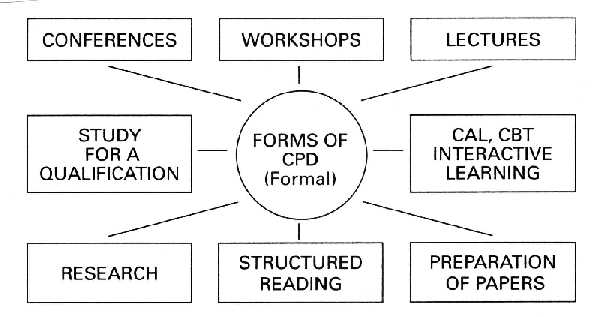
Figure 1. CPD - Formal Models of Learnin0g
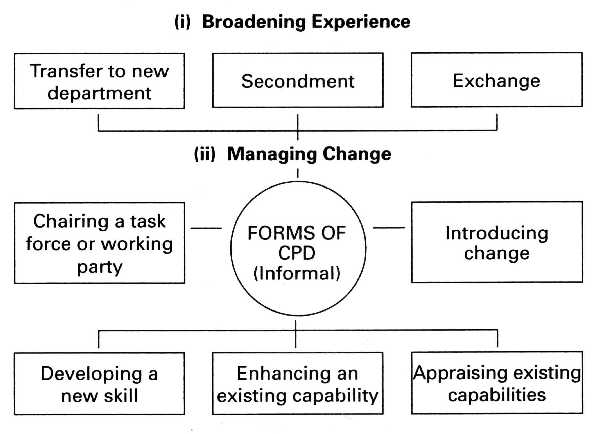
Figure 2. CPD - Structured ‘Development’ Modes of Learning
First, it should be emphasised that the concept of CPD is
not new. Effective professionals in all fields have always realised the
importance of new knowledge, improved skills and developing personal qualities.
In essence CPD is simply part of good professional practice. What is new,
however, is the greater importance and relevance of CPD to professional success.
A recent study performed in the UK (Welsh and Woodward, 1989) identified the
following six reasons to account for the growing importance of CPD:
Competence It has been
estimated that the knowledge gained in a vocational degree course has an average
useful life span of about four years. While this will vary according to the
discipline, it does nevertheless highlight the increasing need to maintain an
active interest in keeping up to date with changing technology, legislation and
operational procedures. It has been estimated that the knowledge gained in a
vocational degree course has an average useful life span of about four years.
While this will vary according to the discipline, it does nevertheless highlight
the increasing need to maintain an active interest in keeping up to date with
changing technology, legislation and operational procedures.
If at the same time professionals have expectations of
increased managerial responsibility, the need to acquire new skills and
knowledge is even more acute.
Consumerism The
development of a more affluent consumer society has also resulted in a better
informed and more sophisticated public. One consequence of this trend is that
they expect a higher duty of care and level of service from their professional
advisors than in the past. Again the skills acquired during an initial training
period or during higher/further education may not equip new staff for this role.
The development of a more affluent consumer society has also resulted in a
better informed and more sophisticated public. One consequence of this trend is
that they expect a higher duty of care and level of service from their
professional advisors than in the past. Again the skills acquired during an
initial training period or during higher/further education may not equip new
staff for this role.
Litigation The
professions are increasingly at much higher risk from claims of negligence than
in the past. Professional indemnity (PI) insurance premiums have risen
considerably in recent years. CPD may not totally eliminate PI claims; however,
if sceptics are worried by the costs of CPD such claims may help emphasise the
potential costs of ignorance! Some evidence is also emerging that insurance
companies may be willing to reduce slightly PI premiums if a structured CPD
programme is available to staff. The professions are increasingly at much higher
risk from claims of negligence than in the past. Professional indemnity (PI)
insurance premiums have risen considerably in recent years. CPD may not totally
eliminate PI claims; however, if sceptics are worried by the costs of CPD such
claims may help emphasise the potential costs of ignorance! Some evidence is
also emerging that insurance companies may be willing to reduce slightly PI
premiums if a structured CPD programme is available to staff.
Standards One of the
primary roles of professional bodies is to safeguard standards of competence.
CPD has a key role to play in the communication of agreed standards and in
ensuring that members comply with specified procedures. One of the primary roles
of professional bodies is to safeguard standards of competence. CPD has a key
role to play in the communication of agreed standards and in ensuring that
members comply with specified procedures.
Quality Assurance The
increasingly emphasis in quality management systems and the ethos of continuous
improvement has also increased the relevance of CPD. Training and education are
key elements of the QA/TQM process. The increasingly emphasis in quality
management systems and the ethos of continuous improvement has also increased
the relevance of CPD. Training and education are key elements of the QA/TQM
process.
Competitiveness The
current recession has re-emphasised the highly competitive nature of modern
business. Whether in the private or the increasingly privatised public/state
sector, the competitive market edge must be partly or totally focused on client
care/service quality or technological innovation. All of these responses demand
a high investment in developing people skills if they are to be effective. The
current recession has re-emphasised the highly competitive nature of modern
business. Whether in the private or the increasingly privatised public/state
sector, the competitive market edge must be partly or totally focused on client
care/service quality or technological innovation. All of these responses demand
a high investment in developing people skills if they are to be effective.
A number of basic features can be identified which
characterise an effective CPD strategy. One useful framework developed by
Ashridge Management College (Willie, 1991) distinguishes between the fragmented
approach and a more focused approach towards CPD.
In this context training and CPD are characterised as
follows. CPD is:
- not linked to organisational goals
- seen as a
cost, not as an investment
- focused on training (discontinuous), not
development (continuous)
- unsystematic
- menu driven, like ordering
from a mail catalogue
- about directive training and knowledge acquisition
- viewed as unimportant and course attendance is frequently cancelled due to
pressure of work or lack of commitment
- not transferred and learning is
rarely implemented back at the office
- viewed as a reward for good
performance.
If this perception of training (and CPD) is viewed as the
lowest point on the scale, the Ashridge researchers offer three increasingly
more sophisticated perceptions of training (and CPD). These are referred to
respectively as the Formalized, Focused and Fully Integrated views. A summary of
this new perception of effective training (and CPD) would include the following
characteristics.
Training and CPD are:
- linked both to organisational strategy and individual
needs
- viewed as an investment in human resource management
- focused
on on-the job development and skills development in addition to knowledge
based training
- evaluated with both pre- and post-course assessment
-
about ‘learning’ as opposed to ‘training’
- transferred to action and
change in the workplace
- flexible in application including open, distance
and self-development approaches.
The changes in the perception of training (and CPD) as
outlined in these two contrasting views are not dissimilar to the current state
of development of CPD within the surveying profession. The fragmented view is
widely held and may help explain the current pre-occupation in many countries
with measuring compliance with CPD and the need to demonstrate attendance at
specific training events rather than being concerned with improved performance
and increased organisational success which is the essence of the second view of
CPD. The challenge for the profession in relation to CPD is to encourage the
second approach. The strategy must therefore address the means by which these
changes in emphasis will occur.
The current emphasis in CPD on ‘compliance monitoring’ and
measures in input (ie not in hours), whilst important, may not fully emphasise
the importance of performance improvement as the output of the process. To
illustrate the point Figure 3 indicates the relationship between CPD and the
four stages in the development of competence from an unconscious level of
‘incompetence’, ie when one is unaware of a need for improvement through the
stages of conscious incompetence (ie I am now aware of the problem), to being
consciously competent (ie I am now capable, with conscious effort, of performing
this task) to being unconsciously capable of performing this task (ie I am able
to operate at this level without conscious effort).
BUSINESS/PERSONAL NEED IDENTIFIED
1. UNCONSCIOUS INCOMPETENCE
(a)
Diagnosis
- self-assessment
- formal
review/mentor
- comparison with competence model
2. CONSCIOUS INCOMPETENCE
(b)
Structured CPD
-
training
- development
3. CONSCIOUS COMPETENCE
(c)
Practice/Application
- planned
- reviewed
4. UNCONSCIOUS COMPETENCE
(d)
Continuous review |
 |
Figure 3. The Stages involved in Improving
Managerial/Professional Performance
CPD at present is focused primarily on developing the link
between Stages 2 and 3. However, this may not necessarily lead to improved
performance because:
(i) the initial diagnosis of the perceived CPD need may
have been inaccurate (ie CPD is not focused on a real need), or
(ii) the application of the CPD (normally in the form of
attendance at a training course) is not applied to the work environment in a
planned and structured manner.
As a consequence CPD will, rightly, not fulfil a real need
and will become viewed (as it is by many) as an interesting but unnecessary
element of professional life.
To overcome the first difficulty further work is necessary
in three areas:
(i) The development of review processes (eg performance
appraisal/career planning reviews) as part of CPD and the development of
competence models for typical career stages.
(ii) The widening of ‘Structured CPD’ to include
‘structured development’ opportunities in addition to ‘ structured training’.
The distinction is illustrated by the formal and more informal modes of
learning, which are illustrated by Figure 1 and Figure 2 above.
(iii) A clearer assessment of the objectives of CPD and
the professional/personal need to which the CPD is related and the manner
in which CPD will be evaluated.
The following are some preliminary thoughts which may be
used as a basis for developing a more structured strategy based on the preceding
analysis.
To assist member associations to put in place the
processes necessary to link CPD more directly to organisational strategies, it
is considered important that the following (modified to local cultural needs)
are included in the organisation:
(i) a process for business planning,
(ii) a procedure for establishing individual objectives
and reviewing these objectives (a process often referred to as a performance
appraisal scheme) and
(iii) a system for recording career and professional
development (sometimes referred to as a Personal Development Plan (PDP)).
Apart from the consequential benefits to CPD these tools
are also increasingly important for organisational development and growth. The
benefit of emphasising the use of PDPs, for example, will help to encourage the
planning of CPD in addition to the recording of the process.
To emphasise further the benefits of CPD it is considered
important that work is expended on the production of structured training
programmes ideally leading to post-graduate/post-experience qualifications. A
number of such initiatives already exist. However, it is felt that additional
work needs to be undertaken to provide further links between discrete CPD
training events and potential qualification structures - at national as well as
at international level. The provision of such linkages will also help provide
further focus to CPD activities.
Simply performing an existing role efficiently is clearly
not appropriate for CPD purposes. What could be effective CPD is the production
of a structured learning plan which leads to demonstrably improved performance
to apply a new skill or utilise new knowledge. This plan may or may not involve
formal ‘training’, eg the conventional CPD events. It may, however, involve the
provision of evidence based on experience in professional life. To be suitable
as CPD evidence this learning would require to be presented in a
structured format, possibly based on the concept of a learning contract
as outlined overleaf.
To be acceptable as evidence for CPD purposes
practitioners would be required to provide evidence of improved performance in
the form of a structured learning contract. The concept of a learning contract
is not new and is used in many educational and training circumstances to help
people clarify the nature of the changes which they wish to implement and to
record the increased capabilities which may follow. The learning contract
requires answers to five questions:
(i) Where have I been (in relation to this CPD need), ie
what is my previous knowledge base and/or experience?
(ii) Where am I now? (what are my current strengths and
weaknesses in relation to the need identified?
(iii) Where do I want to be (what level of skill/knowledge
do I want to obtain)?
(iv) How will I get there (what learning plan/strategy
will I adopt)?
(v) How will I know when I get there (what evidence could
I provide to illustrate improved performance)?
Thus practitioners may bring forward evidence based on
this concept in part fulfilment of their CPD requirement. The implementation of
this more structured approach to learning can also be integrated with the
concept of personal development plans (PDPs) as outlined in the CPD in Practice
section from the UK.
The same concept could be used to improve the existing
arrangements relating to ‘structured reading’ and other forms of more informal
learning.
The growth and complexity of organisations, the demands
from client and the pace of change all require that surveyors possess a wider
range of skills than in the past. Central to the success of the profession
across the world will be the capability of surveyors to demonstrate enhanced
managerial and leadership skills in addition to specialist
technical/professional knowledge. Some of the key management themes relevant to
the surveying profession in the current decade have been outlined in Kennie
(1993) and the case for leadership training, in particular in Kennie and
Gardiner (1988). Professional success demands that such capabilities are not
separate from professional expertise but viewed as complementary, growing in
significance as a surveyor’s career progresses. Figure 4 illustrates some of the
key characteristics of management development.
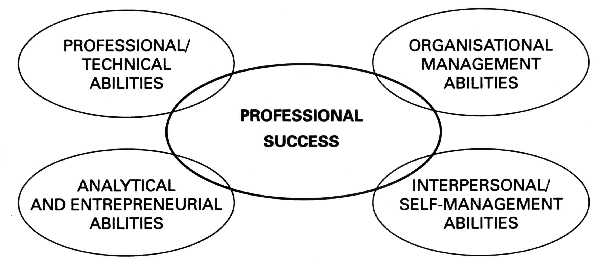
Figure 4. Key Managerial Skills
A recent questionnaire study into the current views of FIG
member associations towards CPD has been carried out by FIG Commission 2
(Kennie, 1992). Responses were received from 30 member association (66% response
rate). The results indicated the following trends:
(a) Almost half the associations who responded have a
FORMAL policy towards CPD.
(b) Whilst at present a minority of associations have
FORMAL guidelines (28% of all member associations), all who responded
were either considering developing formal guidelines or, at the very least,
encouraged members by informal methods.
(c) Of those associations who have a FORMAL policy
towards CPD, only four have adopted a mandatory policy. The majority
encourage members to participate in CPD and adopt a voluntary
approach.
It is clear that the majority of associations not only
favour CPD but are actively involved in its promotion. To take an active part in
promoting CPD the following policy statement was adopted by the General Assembly
of FIG in Melbourne in 1994.
The International Federation of Surveyors (FIG) believes
that a commitment to CPD is essential to the work of the professional surveyor,
throughout his/her working life. FIG, through its member associations, will
provide support and guidance to surveyors seeking to extend their knowledge,
skills and experience.
FIG endorses the concept of lifelong learning which is
implicit in CPD and in particular encourages professional surveyors to:
- produce personal CPD work plans (personal
development plans) which highlight future learning goals,
- view CPD as a continuous development process
which can be satisfied by a balanced and flexible range of formal and
informal learning activities and
- ensure CPD activities are concerned primarily
with the production of enhanced performance (output) rather than being
predominantly concerned with the level of CPD input.
All surveyors need to adapt to the rapidly changing
environment within which they work. CPD, with its emphasis on reviewing personal
capabilities and developing structured action plans to develop existing and new
skills, is becoming increasingly important. The processes outlined in this
publication, together with the case studies of CPD in Practice, provide a
starting point for member associations and individual surveyors to review and
potentially enhance their existing approaches to continuing professional
development.
APPENDIX
The following case studies of 'CPD in Practice' provide a
representative sample of how a number of different countries and organisations
have developed CPD.
The example from the UK provides
details of how a mandatory approach CPD is progressing together with the
development of more sophisticated Personal Development Plans (PDPs), to help
individuals plan their approach to CPD.
The second case study, from Denmark,
outlines how this member association has recently adopted and introduced a
voluntary approach to CPD.
In contrast, case study three from
Sweden offers some insights into the approach adopted by a national mapping
agency and the links between CPD and 'development conversations', a form of
performance appraisal.
The final two case studies, from the
USA and Australia, provide guidance on the
promotion of CPD in a federal system.
CPD IN PRACTICE
– United Kingdom
Current perceptions
The current policy in the United Kingdom towards CPD stems
largely from the strategy outlined in a discussion paper in ‘CPD - Five Years
On’ published in September 1985. This paper was particularly influential in the
promotion of CPD and led to a number of initiatives including:
(a) the extension of mandatory CPD to all members in 1991,
(b) the monitoring of CPD compliance on transfer to
Fellowship and
(c) increased publicity and visibility for CPD.
Over a period of about eight years a number of CPD
initiatives were progressed by the RICS. For a number of reasons if was felt
that there was a need for a review of the success of the existing policy and the
establishment of a new series of initiatives as CPD moved into a new phase of
development. Some of the most significant reasons included:
(i) Evidence from a number of recent surveys indicated
that CPD was viewed by the membership as a process involving "measuring hours of
activity". The emphasis appeared to be on clocking hours and "the need for a
positive desire or need to learn, develop update or increase proficiency" was
considered to be lacking to a significant degree. The emphasis was primarily on
‘input’ measurement, not ‘output’.
(ii) The increasing pace of change in the profession and
the impact of the current recession. Both highlighted the need for practitioners
to have a broader range of professional transferable skills to meet the needs of
the marketplace and prosper in the highly competitive world in which they were
now operating.
(iii) The perception among some members that CPD was
primarily focused on the needs of medium/larger practices who were thought to be
able to provide in-house training. It was therefore perceived to be more
difficult for the sole practitioner or small partnership to support.
(iv) The growing importance of first, Quality Assurance
(QA) with its emphasis on training and, secondly, the increased cost of
professional indemnity insurance.
(v) The perceived need from members for guidance from the
Institution on methods of ensuring quality CPD provision.
To provide a new focus a discussion paper on the future
policy and strategy for CPD was published by the RICS in 1993. It was based on
the development of a number of new initiatives which aimed to help practitioners
reassess their existing approach to CPD and redress some of the deficiencies
identified by the market research.
Features of the new policy
A number of recommendations for future action were
identified in the 1993 discussion document including:
(a) An increased emphasis on the output from CPD
(ie increased performance) in contrast to the previous focus on the input
to CPD (ie number of hours).
(b) The continued development of structured modular
training courses which may lead to post-graduate qualifications (based on a
Credit Accumulation and Transfer Scheme (CATS)).
(c) The production of guidelines to recognise ‘structured
development’ as an integral part of CPD.
(d) The need to assist practitioners in the diagnosis of
their CPD needs by the use of performance appraisal or competence models which
indicate the transferable skills appropriate to Chartered Surveyors at a range
of career stages.
(e) The need to encourage the use of Personal Development
Plans (PDPs) to plan CPD activities, as opposed to solely
recording CPD compliance.
(f) The need to encourage practitioners to view CPD in its
broadest sense and, in particular, to emphasise the growing need for Continuing
Management Development (CMD) to enhance the surveyors skill base in business.
(g) The need to change the guidance to practitioners on
the assessment of CPD needs and the evaluation of the CPD investment.
(h) The need to recognise good practice in the wider
training field including national initiatives such as ‘Investors in People’ and
to communicate such practice within the wider membership.
CPD IN PRACTICE
– Denmark
The current policy on CPD within the surveying profession
in Denmark was recently adopted. However, the concept of CPD is not new. The
need for updating of professional skills has been formally recognised for many
years. What is new is the recognition of the need for structured CPD and the
need for documented professional competence.
The Danish policy on CPD is based on the UK approach
although it differs in that the requirement for CPD activities is not mandatory.
Instead, a voluntary approach was considered adequate and in accordance with
cultural and professional traditions.
The policy has been discussed and developed at regional
meetings within the member association since 1991 and was finally adopted in
1994, when a publication was produced to explain the code of professional
standard and how to comply with the regulations. The publication is presented
below.
The resolution
At the general meeting on 27 August, 1994, the Danish
Association of Chartered Surveyors approved the introduction of CPD - Continuing
Professional Development - as adopted by the executive committee on 24 June the
same year.
CPD came into force on 1 January, 1995.
As from that date, an - at least moral - obligation rests
with every Danish surveyor to fulfil 40 hours of CPD every year, this being the
recommendation of the executive committee. With this the Association has set a
standard. It is, however, up to individual members to meet the requirement in a
manner suited to their own needs.
And what then is CPD?
CPD – definition and practice
"Systematic maintenance and development of professional
competence as well as improvement of personal
qualifications for handling tasks and duties throughout
the professional working life of the individual member". This is the wording of
the CPD definition.
In practice, CPD simply means continuing professional and
personal development and training to maintain high professional competence. CPD
is a process, in which each person currently updates and extends his/her
specific professional knowledge and abilities, and consequently offers
consultancy and services of the highest quality.
With CPD the scene is laid for strategic considerations,
both for the individual and for the single firm.
Where do I/we want to go? What is the goal? How do I/we
then get from the position of today to the goal of tomorrow?
One of the aims of CPD is just that: you begin to view
yourself and your firm in a lifelong development perspective. With that CPD
becomes a decisive condition of success.
Why CPD?
It has been estimated that professional knowledge acquired
through, for example, a higher education is in many cases only up-to-date for
about four years.
We also know that knowledge and professional competence is
no longer given once and for all. It must be maintained and extended through a
lifelong process of learning. CPD is a tool in that process.
There is every indication that CPD activities will become
an important condition of developing and maintaining a high level of service and
in the work with the formulation of a business strategy.
CPD will also increasingly become a standard for quality -
for example, in connection with public invitations to tender - and a condition
of being considered in connection with previous qualifications.
For the surveyor employed in the public or private
sectors, the CPD results will be an important asset in the development of
his/her job profile. And it may be a decisive asset on employment in a new job
and on promotion.
How?
Fundamentally, CPD comprises all the activities leading to
professional and personal development and which are not contained directly in
the daily work.
The contents of the single CPD activities will depend on
the professional work of the individual. The most common forms of CPD will
probably be:
- Courses, seminars, symposia and workshops
- Congresses, conferences and other professional
meetings
- Study circles and study visits
- Structured supplementary training
- Distance education - educational packages, also
electronic (PC, CD-ROM)
- Open education
- Structured reading to gain a deeper insight into
a certain professional subject.
- Writing of articles for professional periodicals
as well as holding of professional courses and lectures
- Active participation in professional commissions
and boards
- Assignments/work abroad
- Development work
Registration
The enclosed form is for your personal use. At the back
you will find the directions to enable you to complete the form
Each time you carry through an activity, which updates,
strengthens or extends your professional competence, you can enter details on
the form.
In this way you have a comprehensive view yourself.
However, what is more important, is that you can demonstrate your updated
professional competence to others.
And this becomes increasingly important. After all it is a
question of quality. Quality and documented professional competence, e.g. in the
form of the CPD survey, may be decisive in a competitive situation
The customers make demands
There was a time when we qualified for life, once and for
all. That was in the time of the static society. Today we must qualify
constantly just to keep up. Legislation is changed and adapted at shorter and
shorter intervals. Technological development only seems to accelerate. The
contents of the tasks change their character, and at the same time traditional
processes become less important.
Therefore, the customers are increasingly demanding
documented professional competence. And therefore CPD - Continuing
Professional Development - is an absolute necessity. There are, however, other
reasons for its growing importance.
Therefore CPD is necessary
The products and services offered by Chartered Surveyors
are founded on personal knowledge. Success or failure is determined by the
knowledge and experience of the individual. Therefore professional competence is
decisive, both to the employee and to the self-employed.
The knowledge and insight held by the surveyor must
continuously be extended and developed. Flexibility, adaptability and renewal
become vital if we are to compete effectively.
CPD is a tool in this personal and professional
development process.
Central qualities
The key points of CPD are that it is
Constant
It is a development process that lasts the entire professional life.
Task and market-orientated
Competence to manage existing tasks on new terms and to undertake quite new
tasks on a qualified basis is constantly raised.
Broadly founded
Knowledge, skills and personal qualifications are improved concurrently.
Structured
It is a well-considered and systematic strategy for each individual person. One
purpose of CPD is to view yourself and the firm in a lifelong development
journey.
Documented
With the CPD survey the individual member can prove his qualifications - his
updated professional competence - in accordance with the professional and
technological development and the requirements of society. And he/she can
maintain the comprehensive view of his/her own development.
Advantages and responsibility
CPD is about knowledge and quality, two fundamental
elements of success. With the introduction of this concept, the Association has
defined a framework, but the fulfilling of the framework is the responsibility
of the individual. The CPD concept is an offer which, in the medium term, may
provide great opportunities and advantages to both the individual, the firm/the
authority and the entire profession of Chartered Surveyors.
The way forward
It is a process. In its present form, CPD is not a final
concept. It will be adapted according to the experiences which we will gain.
This folder introduces the concept and is the signal to initiate the process
started to take effect as from 1 January, 1995.
CPD IN PRACTICE
– Sweden
By Bo Nyberg, Director, National Land Survey,
Sweden
Continuing Professional Development in The National Land
Survey of Sweden
– A Brief Overview
Basic assumptions
In the decentralized organization at the National Land
Survey of Sweden, responsibility for personnel and management development is as
follows:
1. The nearest manager is responsible for daily support,
including necessary reactive tasks and local forward-planning measures.
2. The central personnel department is responsible for
providing programs and activities corresponding to basic organizational
demands.
3. The central personnel department is also, at the
request of top management, responsible for planning the future needs of
leadership development.
Development conversations/appraisals
In 1989 an agreement was established between the NLS and
the employee organizations concerning personal development in the Land Survey of
Sweden. One of the major issues was development conversations.
The mutual intentions were:
– to give the employer possibilities for discussing
goals, business ideas, etc. with everybody in the organization,
– to find
out the consequent needs for further training/development (a basis for
planning),
– to give each employee an opportunity to discuss and influence
the personal work-situation, to encourage a willingness to take on new work
assignments and to receive appropriate training for this work and, finally, to
– discuss mutual goals.
In short, to do everything possible to achieve both good
production results and high work satisfaction.
Since 1990 development conversations have become
compulsory in the Land Survey of Sweden. On regional/local courses the NLS
trained all managers in the process of conducting such conversations. Every
manager is expected to fit the needs of the individuals into a yearly local
development plan, to secure the funding and to review the results.
In a attitude survey throughout the whole Land Survey of
Sweden we found out that 60 - 70% of the managers have regular appraisals.
Unfortunately 50% of those answering the survey said that they were satisfied
with the quality of their development conversation, causing our Director General
to act in the top management group, demanding progress in both quantity and
quality.
Leadership development
In 1989 a leadership support program was worked out in
order to provide the necessary skills for the 1990's. The program consisted of
ideas about how to recruit managers, mentoring of staff, how to conduct yearly
appraisal talks between managers, etc. One further area was leadership
development.
Planned leadership development is divided into three
parts.
1. Searching for presumptive leaders in our
organization and placing them in a preparatory program.
2. Introductory contributions during their first year in
the new position for those who are newly appointed managers.
3. Leadership development programs for those who
have been managers over a period exceeding one year.
Suitability for management work is a result of a dialogue
with and is approved by the nearest manager. When appointing somebody for a
higher management position assessment is performed with support from the central
personnel department.
Preparatory programs for presumptive leaders are carried
out at regional/local level with requested support from an internal
organizational consultant from the central personnel department.
The introductory program for newly appointed leaders is a
central activity organized by the personnel department with support from top
managers from various fields of activity.
Leadership development programs
In 1992 the top management decided upon a long-range,
central leadership development program, divided into four parts:
Part 1: effective group leadership
Part 2: business
economy
Part 3: leader in a changing organization
Part 4: personnel work
for leaders.
Top management also decided upon an immediate compulsory
implementation of Part 1. Since the Land Survey of Sweden is subjected to a
governmental investigation concerning future work and organization our top
management decided that Part 3 should be implemented as well. Part 2 and Part 4
will be developed in due course.
Effective group leadership (Part 1)
This is a five day residential course with evening
sessions.
The target group is managers who are committed to becoming
more effective group leaders, regardless of management level.
The effective group leadership course is designed to:
– increase your ability to lead and motivate people
working in groups
– increase your ability to develop creative, effective
solutions to task and relationship problems within a group
– increase
your ability to identify and manage your personal strengths and weakness
as a manager and leader
– increase your ability to give and receive
performance feedback, including both criticism and praise
– increase your
ability to manage conflicts within your management or work group,
even when you are personally involved in that conflict
– increase your
ability to strategically plan for and manage change and its effects
–
increase your self-confidence as a manager and group leader.
"Effective leadership means simultaneously managing both
task-content and group process".
There are always two things occurring simultaneously in a
group: WHAT the group is doing and HOW they are doing it. Many
management and leadership courses deal with either "what" or "how".
Our basic assumption is that what a group does and how
it does it are inseparable and should, therefore, be taught at the same
time. In short we deal simultaneously with content and process skills.
No two effective group leadership courses are ever
identical. We constantly tailor every course to
the needs of course participants and conscientiously avoid wasting time teaching
skills that participants already possess. We have an external partner in this
course, as well as in Part 3. Each course consists of 8 - 12 people plus two
trainers, one from the Land Survey. It is a thorough course that demands the
full participation and commitment of all who attend.
Our experience from this course is extremely positive.
Many managers start developing their own work-place after having attended the
course, often using the internal consultants mentioned.
Leader in a changing organization (Part 3)
Part 3 is not an actual course like Part 1. It consists of
a workshop-oriented contribution in which two consultants - two internal or one
external and one internal - work for three days together with an actual
management group in order to help them find ways of "what" to do and "how" to do
it in trying to deal with the rapidly changing environment.
The overall goal is to increase the ability of the
managers effectively to lead the changes in their own work-place. We support
them in:
- creating a concrete plan (what, who, how, when, etc.)
for dealing with those parts of the changes that are in the organization’s range
of power to influence,
- reducing negative effects of the inevitable from
outside by forming a common - accepted by everybody - strategy,
- teaching
knowledge and giving experience on how to create a common strategy and make
mutual plans for the change process,
- increasing the understanding of the
phases and dynamics of change efforts and, finally,
- improving their ability
to handle people subjected to situations of stress and crisis.
Competence development strategy
Quite recently a competence development strategy was
adopted, stating that competence development is clearly organization-oriented.
Activity needs as well as the needs of the individual form the basis for this
planning. Long range goals are formulated by top management.
Through a constant dialogue each specialist branch is
expected to take responsibility for a good balance between what it offers as
"producer" and the demands of the "consumers".
The different competence development areas are:
– introduction
– continuation courses
– forwarding
courses
– specialist development
– personal growth and
– leadership
development.
CPD IN PRACTICE
– USA
By Jud Rouch, Vice President of the American
Congress on Surveying and Mapping
In the USA continuing education takes on two different
characteristics, that of mandatory and that of voluntary.
Voluntary continuing education has existed for as long as
the professional societies for surveying and mapping have existed - ASPRS since
1935 and ACSM since 1941. Mandatory continuing education is a much more recent
phenomenon. Mandatory continuing education is rapidly becoming legislated for
those professions that are regulated by registration requirements in the USA.
First one must consider what is covered by a surveyor’s
professional registration. All professional registration is by the individual
states and therefore many variations occur within the whole of the USA. Not each
state legislation law covers the exact same definition of what actions are
regulated. All of the states include land boundary determination within their
definition of a registered surveyor’s realm. Other areas of practice that are
regulated in some jurisdictions include photogrammetry, precise positioning on
the various state grids, site layout, and hydraulics. Various components of
surface and subsurface drainage design are also sometimes included. This
variation in definition results in a situation where one must be separately
registered in each state in which one wishes to practise. There is a small
amount of reciprocity between the states, but it is very limited. This
registration requirement dates from about 1950 as the states began to separate
surveying from their definition of civil engineering. A common theme that exists
among all of the various state registration laws is "to protect the public".
There has been a movement to legislate certain amounts of
mandatory continuing education by some of the states as a requirement for
continuation of registration during the past fifteen years. It has been the
individual state surveying societies that have ignited this movement.
I believe that Iowa was the first state to enact
continuing education requirements. The time frame for that was somewhere about
1975. The latest American Congress on Surveying and Mapping (ACSM) summary sheet
that is available is dated in December 1988. It lists eight states with formal
legislated requirements at the time. I believe that a 1993 summary would list
approximately one half of the fifty states as having legislated mandatory
continuing education either in effect now or effective for a future date. The
National Society of Professional Surveyors (NSPS) is a member organization of
ACSM. It adopted a model law for the individual state surveying societies’
guidance in formulating its own legislative proposals in 1990. This model law
was developed from the existing laws of the various states that were in effect
at the time of the last ACSM summary listing of 1988.
"The Council on the Continuing Education Unit is a
non-profit federation of educational and training organizations devoted to the
constructive and consistent use of the Continuing Education Unit and to
improvement of the quality and effectiveness of continuing education training
and development". The Council has defined the Continuing Education Unit (CEU) as
ten hours of "participation in an organized continuing education experience
under responsible sponsorship, capable direction and qualified instruction".
Most USA universities maintain membership in this Council. The aforementioned
NSPS model law defines a Professional Development Hour (PDH) as equal to 0.1 CEU
or one hour of contact including 10 minutes for break time.
Some states are very strict about credit for PDH’s being
limited to formal classroo type instruction while others allow PDH credit for
such activities as membership in professional surveying societies, attendance at
conferences, presentation of papers and serving in society offices or on
committees. Some even allow credit for at stated minimum numbers of hours of
professional practice during the preceding year.
The classroom type continuing education instruction is
being conducted in several different ways. Each state society schedules at least
one conference per year where formal classes are held. Typically, a practitioner
would have to attend more than one such conference per year in order to satisfy
the mandatory requirements. The ACSM has two conferences each year that have at
least 24 contact hours of continuing education available during their meeting
week. Several private enterprises have come into existence in the USA whose only
purpose is to contract to provide continuing education classes for various
seminars around the country. In addition, most university professors in the
surveying field are requested to donate their time to provide training classes
at the various state society conferences on occasions.
The problem of verifying attendance at these educational
sessions is handled differently by the various state boards of registration.
Some rely upon signed word of the attendees while others require elaborate forms
of proof of attendance. In some states the professional societies maintain
records of attendance, while in others the boards of registration send official
observers to keep tally. The ACSN had a program of recording the members’
attendance at continuing education activities but that has not been continued in
the recent past. As more and more states enact legislation mandating continuing
education and as most practitioners are registered in several states, it seems
that a more effective means of verification and recording keeping will become
essential.
In the future most if not all states in the USA will
require continuing education as a condition for continuance of registration in
order to operate in private practice. At the present time, this is mostly
limited to those areas associated with boundary determination, but it will
probably be extended to other areas of professional practice. Mandatory
continuing education for professional surveyors is here to stay in the USA.
CPD IN PRACTICE
– Australia
By Selby Munsie, Honorary Secretary of the
Institution of Surveyors, Australia.
Introduction
Professionals and academics have recognised that a finite
3 or 4 year degree does not provide a complete professional education, nor does
it equip the practitioner with the skills and knowledge to span the lifetime of
an individual’s career. The events leading to the Institution’s interest in, and
the beginning of, the CPD movement are described by Munsie and White (1980). The
essential points made by both authors encompassed the following:
- Technical/technological updating
- Management training
- Community involvement
- Liberal arts and humanities.
It is the aim of this paper to examine the various
proposals suggested by the Divisions of the Institution with respect to the
Council guidelines for CPD and to present a document for the consideration of
the membership. The principal questions are focussed on the flexibility of
models in continuing professional development and possible alternatives to
satisfy personal, professional and community requirements. Is there a another
solution? The introduction of mandatory CPD to the Institution is proposed from
January 1, 1994. The resolution of the Council of the Institution states:
"broad guidelines be developed for the implementation of compulsory continuing
professional development to commence in 1994 for continuing membership of the
Institution".
Divisional programs
Table 1 shows the policy of the implementation of CPD
programs by five of the Divisions of the Institution. They signify general
attitudes which could positively respond to the needs of the profession.
Divisions which have a CPD policy are:
|
State |
Operational CPD
Program |
Years in
operation |
Voluntary/
Mandatory |
|
NSW |
Yes |
2 years |
Voluntary |
|
NT |
No |
N/A |
- |
|
Qld |
Yes |
3 years |
Voluntary |
|
SA |
Yes |
being implemented ‘93 |
Mandatory |
|
Tas |
Yes |
4 years |
Voluntary |
|
Vic |
No |
N/A |
- |
| WA |
Yes |
being implemented ‘93 |
Voluntary |
Table 1
In its capacity as a Manager, the Council has set out the
following objectives for its active involvement in CPD, the requirements for
members and the definition of CPD:
Objectives
- The preservation and enhancement of high standards of
professional performance by its members throughout their careers.
- The ensuring of currency in surveying knowledge by
its members.
- The increase in individual surveying capability as a
contribution to national development.
- The provision of a formal structure in support of
continuing professional development activity by its members.
- The undertaking of an adequate level of continuing
professional development by its members.
- The formal recognition of members’ achievements in
continuing professional development.
- The availability of appropriate continuing
professional development opportunities for its members.
- The support of relevant continuing professional
development activities by the employers of professional surveyors as part of
the employees normal duties.
Requirements of members
Members of the Institution are required to comply with the
Code of Ethics promulgated under By-Law 59 of the Constitution and By-Laws. Item
5 of the Code of Ethics states that:
"A member shall endeavour to advance the science and
practice of surveying and the objects of the Institution and shall
continue his professional development throughout his career and
encourage the development of his subordinates."
Definition of professional development
Professional development
is defined as the process by which professional surveyors maintain the quality
and relevance of professional service throughout their careers. It has two
components - professional experience and continuing education.
This definition, together with the intent of Item 5 of the
Code of Ethics, requires that members of the Institution undertake a compulsory
program of continuing professional development comprising the two elements of
professional experience and continuing education.
Professional experience
is the practical experience gained throughout a person’s career and varies
according to the nature and scope of an individual’s employment.
Continuing education is
the study undertaken by professionals to extend or update their knowledge, or to
prepare them to meet advances or changes of direction in their careers. is the
study undertaken by professionals to extend or update their knowledge, or to
prepare them to meet advances or changes of direction in their careers.
The stating of these objectives gives a broad base for the
states to build upon in implementing items 4, 5, 6 and 7.
Closing remarks
Integral to the current CPD requirements of the Divisions
and the general policy of the Institution of Surveyors, Australia are the four
areas generally regarded as essential to the CPD concept:
- Technical/technological updating
- Management training
- Liberal arts and humanities education
- Community involvement.
Individual members of the Institution should then respond
as to whether these models have sufficient flexibility to meet their personal
and/or professional requirements. The continuity of membership of the
Institution will be subjected to a successful implementation and completion of
specific aspects of CPD.
The accounting profession has implemented the CPD program
effectively. Many other professions have either built in mechanisms or formal
CPD programs. It is hoped that the profession of surveying as part of a broader
area of land information science will not only receive wider recognition by the
community at large, but also adopt CPD as an essential ingredient to meet
changing requirements.
Enemark, S (ed.) 1993.Facing the Educational
Challenges of the Future. Proceedings FIG Commission 2 Workshop, Aalborg,
Denmark, 243 pp.
Kennie, TJM. 1992.
Continuing Professional Development and FIG Current Practice and Future
Development. Proceedings 59th FIG PC Meeting, Madrid, Spain, 15 pp.
Continuing Professional Development and FIG Current Practice and Future
Development. Proceedings 59th FIG PC Meeting, Madrid, Spain, 15 pp.
Kennie, TJM. 1993.
Management Does Matter: Some Key Themes for the 1990's. Proceedings of Survey
and Mapping ‘93, 12 pp.
Kennie, TJM. and Gardiner PF, 1988.
Leadership Training for Chartered Surveyors in the United Kingdom - A Programme
of Continuing Education. Proceedings FIG Commission 2 Symposium ‘ University
Education for Surveyors’, Madrid, Spain, 15 pp.
Munsie, S., 1994.
Continuing Professional Development - A Unified Approach. The Australian
Surveyor, Educational Supplement 1994, 10 pp. Continuing Professional
Development - A Unified Approach. The Australian Surveyor, Educational
Supplement 1994, 10 pp.
Royal Institution of Chartered Surveyors (RICS).
1993. CPD- Review of Policy and Future Strategy, 19pp. (also various documents
to support CPD in practice, eg CPD Starter Pack and Personal Development Planner
(PDP)).. 1993. CPD- Review of Policy and Future Strategy, 19pp. (also various
documents to support CPD in practice, eg CPD Starter Pack and Personal
Development Planner (PDP)).
Welsh L. and Woodward P., 1989.
Continuing Professional Development: Towards a National Strategy. Dept. of
Education and Science PICKUP Report, Planning Exchange, 51 pp.. Continuing
Professional Development: Towards a National Strategy. Dept. of Education and
Science PICKUP Report, Planning Exchange, 51 pp.
Willie E. 1991. People
Development and Improved Business Performance. Ashridge Management Research
Grou,. HMSO, 89 pp. People Development and Improved Business Performance.
Ashridge Management Research Grou,. HMSO, 89 pp.
|


























